
Nevertheless

Image by Mejimages from Pixabay

Greetings as summer winds down here in the Northeast United States!

Wherever you are on this amazing planet earth, I hope you are feeling well.

Today’s song was created by a Boston-based singer-songwriter named B. Iris Tanner whom I have known for many years.

Iris alludes to a bunch of standards from the Great American Songbook in her lyrics for “Nevertheless” including:

“Loved Walked In” (by the Gershwin Brothers),

“Old Devil Moon” (by Yip Harburg and Burton Lane),

“My Heart Stood Still” (by Lorenz Hart and Richard Rodgers),

“If I Were A Bell” (by Frank Loesser),

“I’ve Got You Under My Skin” (by Cole Porter),

“Bewitched, Bothered and Bewildered” (by Lorenz Hart and Rochard Rodgers),

“The Nearness Of You” (by Ned Washington and Hoagy Carmichael),

“I’ve Grown Accustomed To Her Face” (by Frederick Loewe and Alan Jay Lerner),

“I Could Write A Book” (by Lorenz Hart and Richard Rodgers), and

“When Irish Eyes are Smiling” (by Ernest Ball, George Graff, and Chauncey Olcott).
It’s quite a list!

And there may be more musical references which I have missed…

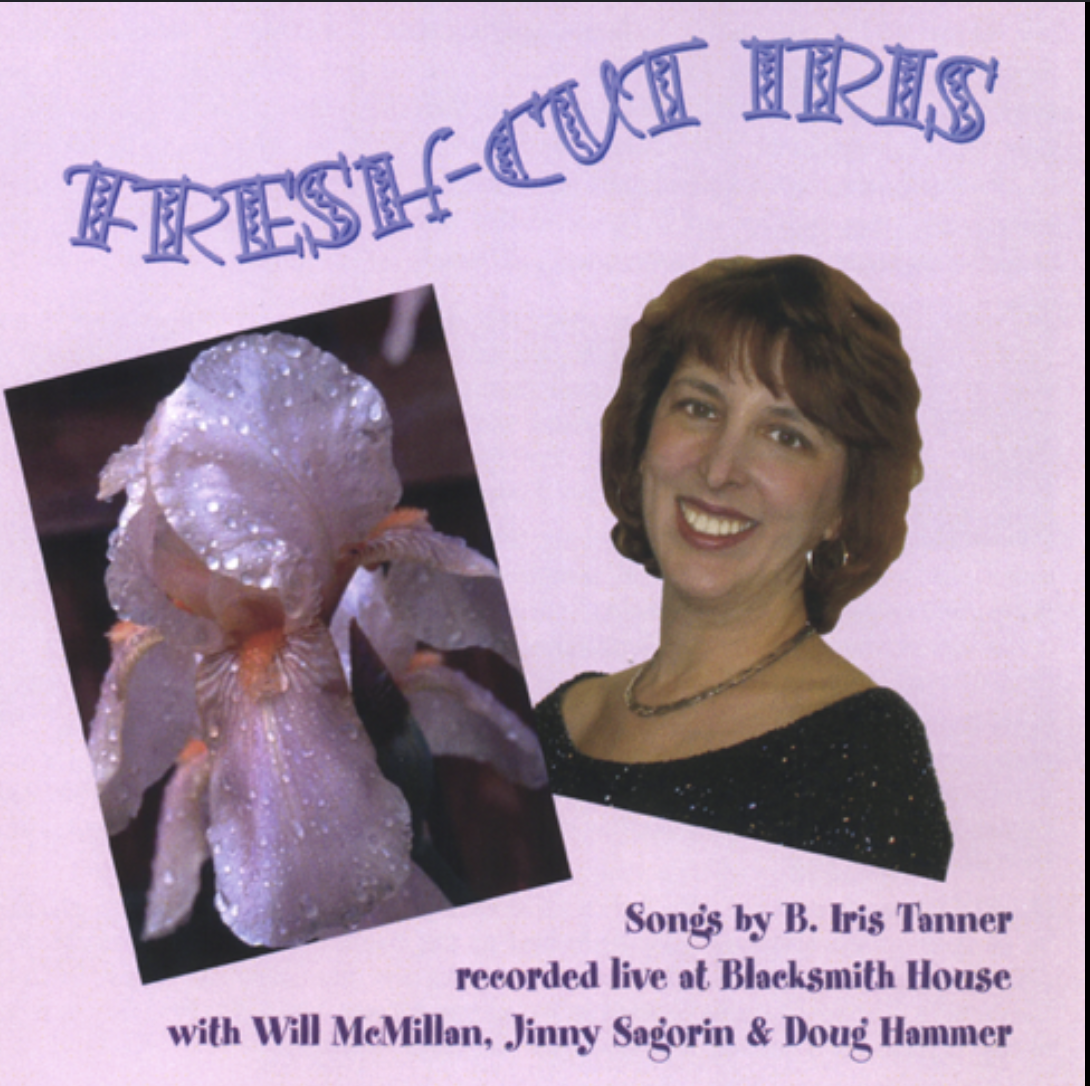
Iris put out a collection of her original songs — FRESH-CUT IRIS — a while back and included a live version of me singing “Nevertheless” (which she recorded at The Cambridge Center for Adult Education when I was working there (and co-hosting monthly open mic nights, too).

The version in the player at the beginning of this blog post, however, is one I recorded with pianist Doug Hammer when I thought I might release a CD of songs written by Boston-area songwriters (of which there are many!)

Then we added drum and percussion tracks by Gene Roma along with a bass track by Chris Rathbun.

This recording has sat — blessedly archived by Doug in zeros and ones — for a couple of decades.

And now it is seeing the light of day.

Hurrah!

Deep breath in.

Deep breath out.

As I wrote in a recent blog post, I am saddened that so many people — including myself — have to keep learning the latest version of everything (as well as updating our hardware and software) in order to use our laptops, our cell phones, the internet, etc.

What a waste of our precious lives here on planet earth!

Thus I am VERY grateful that Doug is willing to stay on top of this endless updating process as it relates to his recording equipment — in addition to remaining a splendid pianist.

Doug owns a bunch of great microphones, various boxes through which he runs audio information, and a powerful Apple computer which is loaded with extraordinary amounts of software.

AND he know how to use all of it quite seamlessly and reliably.

Astounding!

But when it comes to rehearsing, performing and recording music, we also use an actual instrument — his piano.

I love that no one has updated the basic mechanics of an acoustic piano for hundreds of years (although there ARE plenty of electronic keyboards which are continually being updated and “improved”).

I learned from ye olde internet that over three hundred years ago, an Italian harpsichord maker — Bartolomeo Cristofori di Francesco— created a new instrument in which strings were hammered rather than plucked..

This is what became known as a “piano.”

Here’s a link to a short history of the piano written by a fellow WordPress blogger named Viktorya Stepanyan if you are curious.

The mechanisms and construction materials for pianos have been tweaked over time, but generations of pianists have NOT had to re-learn over and over and over again how a piano functions.

The Schimmel grand piano which Doug plays at his studio, the Kawai baby grand piano which Molly plays when we rehearse at her house, and the Ivers & Pond upright piano (made here in Boston) in my living room all work the same way.

Another deep breath in.

And deep breath out.

There IS one change in piano construction, however, which I am glad to note.

Image by Barbara Fraatz from Pixabay

Ivory from elephant tusks is no longer used to make the surface of the white keys — as was done on my hundred-plus-years-old Ivers & Pond piano.

I sometimes pause and try to imagine the former lives (and deaths) of the elephants whose ivory tusks live on as part of my old piano’s keys…

Did they live in Africa?

In India?

In a zoo or circus here in the USA?

A Google search reveals that a LOT of piano-key ivory came from African elephants.

And the reason people liked to kill these huge and heartful beings is that “ivory was highly prized for its durable, slightly porous, and ‘cool’ texture, which helped absorb moisture from a pianist’s fingers” while they were playing.

What a strange and short-sighted species we human are — killing other animals in order to make our own music…

Yet another deep breath in.

And deep breath out.

I am happy to report that no elephants were killed to create the Schimmel grand piano at Doug’s studio or the Kawai baby grand at Molly’s house.

Graphic design by Stephen Fischer

And I am excited — finally — to be sharing Iris’s lovely song with my fellow bloggers, family, friends, and fans.

Thank you to to Iris for writing this song, to Doug for playing (and also mixing) this song, to Stephen C. Fischer for his graphic design skills, to Gene and Chris for adding their musical chops to the mix, and to to the photographers at Pixabay for their lovely images,

And thank YOU for reading and listening to yet another one of my blog posts!

One more deep breath in.

And deep breath out.

PS: You are welcome to click here to stream this new version of “Nevertheless” if you are so inclined.

PPS: And if you are willing to “like” it and/or add it to a playlist, that apparently increases the chances that this recording will be shared with more new listeners.

This Heart Of Mine…

Image by xiSerge from Pixabay

Thank you to everyone who continues to explore my blog even though I have not been posting a lot lately.

It is very exciting — and satisfying — to check my stats and see the many different blog posts people have visited during the past week.

One blog post which gets a surprising (to me) amount of traffic is about the composer Harry Warren.

He wrote the music for the song in the player at the beginning of this blog post along with lyricist Arthur Freed.

You can click here if you are curious to learn more about Harry Warren by reading my extremely loooong blog post from eight years ago (which also includes recordings of several of his hit songs).

Mr. Warren and Mr. Freed wrote “This Heart Of Mine” for a 1944 Metro-Goldwyn-Mayer (MGM) musical called the ZIEGFELD FOLLIES which starred Fred Astaire.

I think I first heard it sung by Judy Garland, who recorded it the following year for Decca Records.

Arthur Freed also wrote the lyrics for a bunch of other hit songs — such as “Singing In The Rain,” “You Are My Lucky Star,” and “Make ‘Em Laugh.”

You can click here to check out his Wikipedia page if you are curious to learn more about him.

I haven’t read any biographies about him (yet) but according to Wikipedia, he lived a fascinating life.

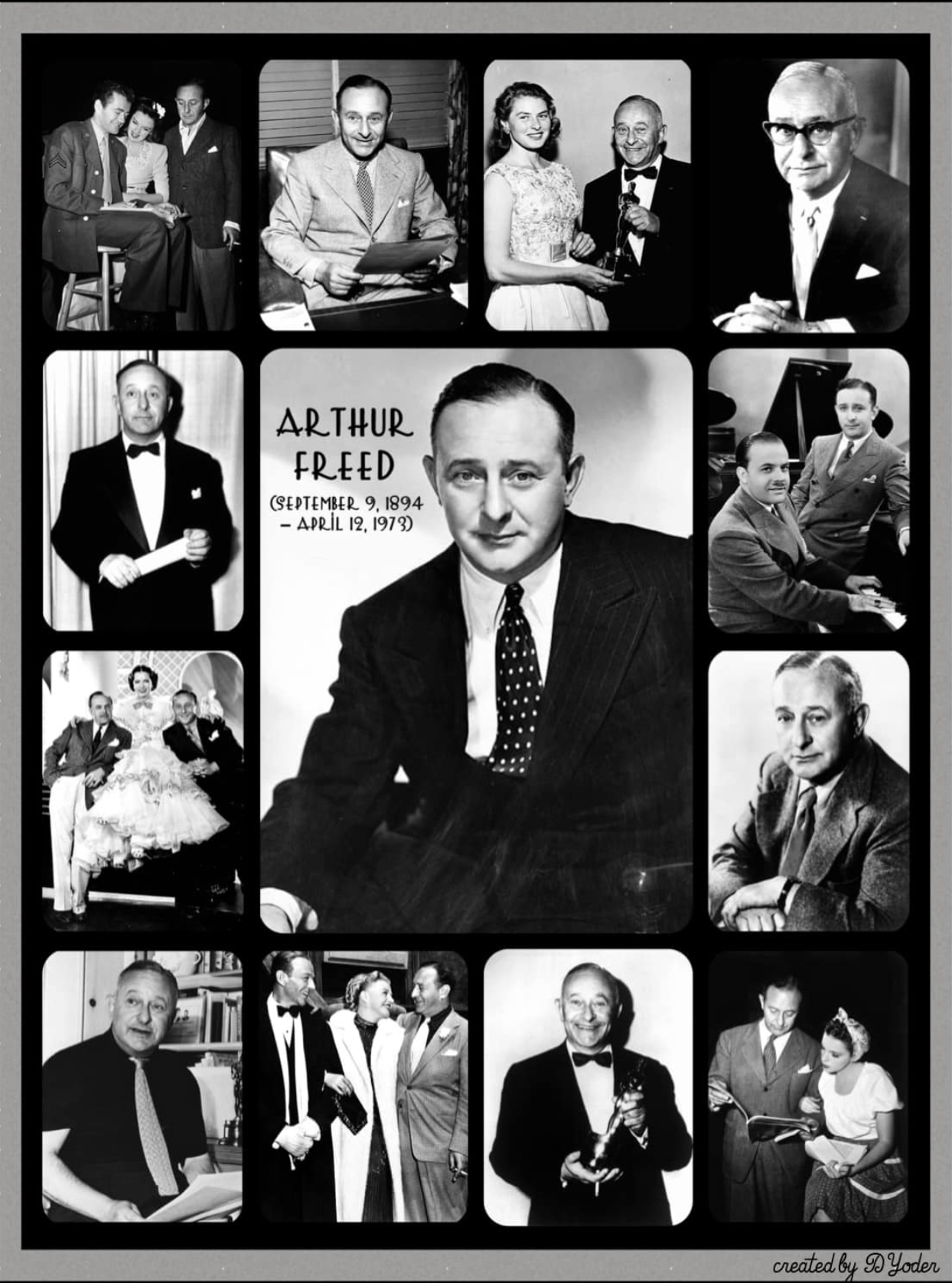
Composite Images of Arthur Freed by Diane Yoder

He was born in South Carolina in 1894, and ended up attending a very prestigious prep school in New Hampshire — Phillips Exeter Academy. I am guessing he was probably one of very few Jewish students on campus — and according to Wikipedia, he became interested in writing poetry there.

After prep school Mr. Freed ended up in Chicago and performed with early versions of the Marx Brothers act (!!!) in vaudeville.

He also wrote special material for them, which led to co-writing enough successful songs that Hollywood beckoned…and he was hired to write songs for early MGM musicals.

After many years at MGM, Freed transitioned from songwriter to producer, working (as an uncredited associate producer ) on THE WIZARD OF OZ and then officially producing his first movie, BABES IN ARMS.

Both of these films, as you probably know, starred Judy Garland.

Mr. Freed went on to produce many more of Garland’s movies including LITTLE NELLIE KELLY, FOR ME AND MY GAL, THE CLOCK, and MEET ME IN ST. LOUIS — which is where she met her second husband, the director Vincente Minnelli, whom Freed had brought from New York City to work at MGM.

According to Wikipedia, Freed hired great talent and then gave them free rein to do their thing — whether it was choreography, costumes, set design, songwriting, direction, etc.

He also gave himself free rein to do some very odd and abusive things, such as exposing his penis to a young Shirley Temple when she came for a visit to discuss doing a movie at MGM — and making sexual advances towards her mother as well.

Temple wrote about this incident in her autobiography — and apparently Mr. Freed experienced no censure as a result of his horrible behavior…

Deep breath in.

Image by Miroslav Kaclík from Pixabay

Deep breath out.

This reminds me of the ongoing conversations about Michael Jackson’s artistic and personal legacies…

Does one discard and avoid the music/art/products made by someone who does horrible things to other beings?

One of Mr. Freed’s most famous movies is SINGING IN THE RAIN, which re-used a bunch of his early hit songs.

Do we stop delighting in the the extraordinary dancing and singing of this movie because the producer was at times a perverse, abusive creep?

Perhaps this is something each one of us must decide for herself/himself…

I apologize for veering into this intense psychological and ethical territory.

I thought this blog post would be more light-hearted — to match the mood of the song.

However, human life is many-layered… full of contradictions, fallibility and mistakes.

Thank you to the (sometimes very flawed) songwriters who have given us wonderful music to lift our spirits year after year after year.

Graphic Design by Stephen C. Fischer

Thank you to pianist/producer Doug Hammer for his tremendous collaborative gifts.

Thank you to graphic designer Stephen C. Fischer for his ongoing work on behalf of my music.

Thank you to the photographers at Pixabay and to Diane Yoder for her composite image of Arthur Freed.

And thank YOU for reading and listening to another one of my blog posts.

If you’d care to stream this song — and maybe even “like” it — on your favorite music streaming platform, you are welcome to click here.

And you are always welcome to visit my website — and sign up for my very sporadic and under-utilized emailing list — by clicking here.

I Wait…

I Wait…


“I Wait” was written by Steve Sweeting, a songwriter, jazz pianist, and teacher who currently lives in NYC.

He and I have been friends since we began making music together in Allston, MA, a couple of decades ago.

“I Wait” is one of many songs we recorded two years ago for a CD of his music called Blame Those Gershwins.

I love this song’s bittersweet, thoughtful perspective.

Berlin

It articulates how I often felt while I had a day job — and only made music at night and on weekends…

Monkey

It wasn’t until I was laid off by the non-profit organization where I had worked for 16 years that I finally dared/cared to focus on music full time.

Making it.

Leading classes where we do it together.

Recording it.

Sharing it in retirement communities and assisted living facilities and public libraries.

That was almost five years ago.

And I am now grateful that I was laid off — although I was surprised and shocked and disappointed at the time.

Kuwait

Some of us (such as me) become so grooved/entrenched in the flow of our lives that we need to be forced by outside circumstances to make important changes.

BrickCamouflage

I do not think that waiting is a bad thing.

Kingfisher

Patience can be a virtue.

Learning to delay gratification can be a huge developmental step on the path to maturity.

cheetah
And some animals wait patiently for hours before making their next move.

But — if I understand the concept of yin/yang correctly — within a reservoir of waiting there also lies a seed of activity germinating…

PotatoSprouting

Just as our torrents of activity/accomplishment need to be interspersed with spaces of calm reflection and “not-knowing.”

Time to mull.

ChileTime to muse.

owl
Time to dream.

Meerkat
Time to imagine the consequences of how our actions might ripple for seven generations into the future here on planet earth…

WillSilhouetteCayugaLake2013

What kind of balance are you able to find in your daily life between waiting and doing?

Thank you for reading and listening to this blog post.

SeedSprouting

And thank you to the photographers who made these beautiful images I found at Pixabay — and also to my sister Christianne, who (I think) took the photo of me gazing out over Cayuga Lake a few summers ago.

hourglass
Tempus fugit…