Earlier this year a fellow WordPress blogger directed me to new research from the University of Gothenburg in Sweden.
The study — named ‘Kroppens Partitur’ or ‘The Body’s Musical Score’ — monitored the pulses of fifteen choral singers as they made their way through three different exercises: humming, performing a hymn, and chanting a slow mantra.
The authors of the study reported:
“When you are singing, the heartbeat for the whole group is going up and down simultaneously…It gives you pretty much the same effect as yoga breathing. It helps you relax, and there are indications that it does provide a heart benefit.”
This synchronization is thought to be caused by the breathing patterns which the music inspires in the singers.
When they are singing the same melody, they tend to pause to breathe in the same place, and these breathing patterns then influence their heart rates.
I love learning about this research, because it corroborates what human beings have experienced for thousands of years — singing with other human beings is a special, healthy and often uplifting experience.
It also reminds me how important it is to include “sing-along” songs as part of a performance.
Who wouldn’t want an opportunity for a room full of people’s hearts to synchronize?
“Blue Moon” by Richard Rodgers and Lorenz Hart is a song which Bobbi Carrey and I included in our In Perfect Harmony show in hopes that people might sing (or hum or whistle) along with us.
I have included a version that we recorded with Doug Hammer on the piano at the very beginning of this blog post.
I have long been aware of how intimate singing with another person can be — whether in unison or in harmony — but I didn’t realize that Bobbi and I might actually be synchronizing our heartbeats when we perform together.
I have been been blessed to sing wonderful songs written by other people for many years — as the MP3 player on the right hand sidebar of this page can attest.
And every now and then I have helped to co-write a song.
But it wasn’t until a few years ago, when I bought my first ukulele, that I started writing songs on a regular basis.
The song in the player at the beginning of this blog post is one I recorded using my this ukulele and Apple’s wonderful GarageBand program on my laptop.
I love learning about how other songwriters have created their hits.
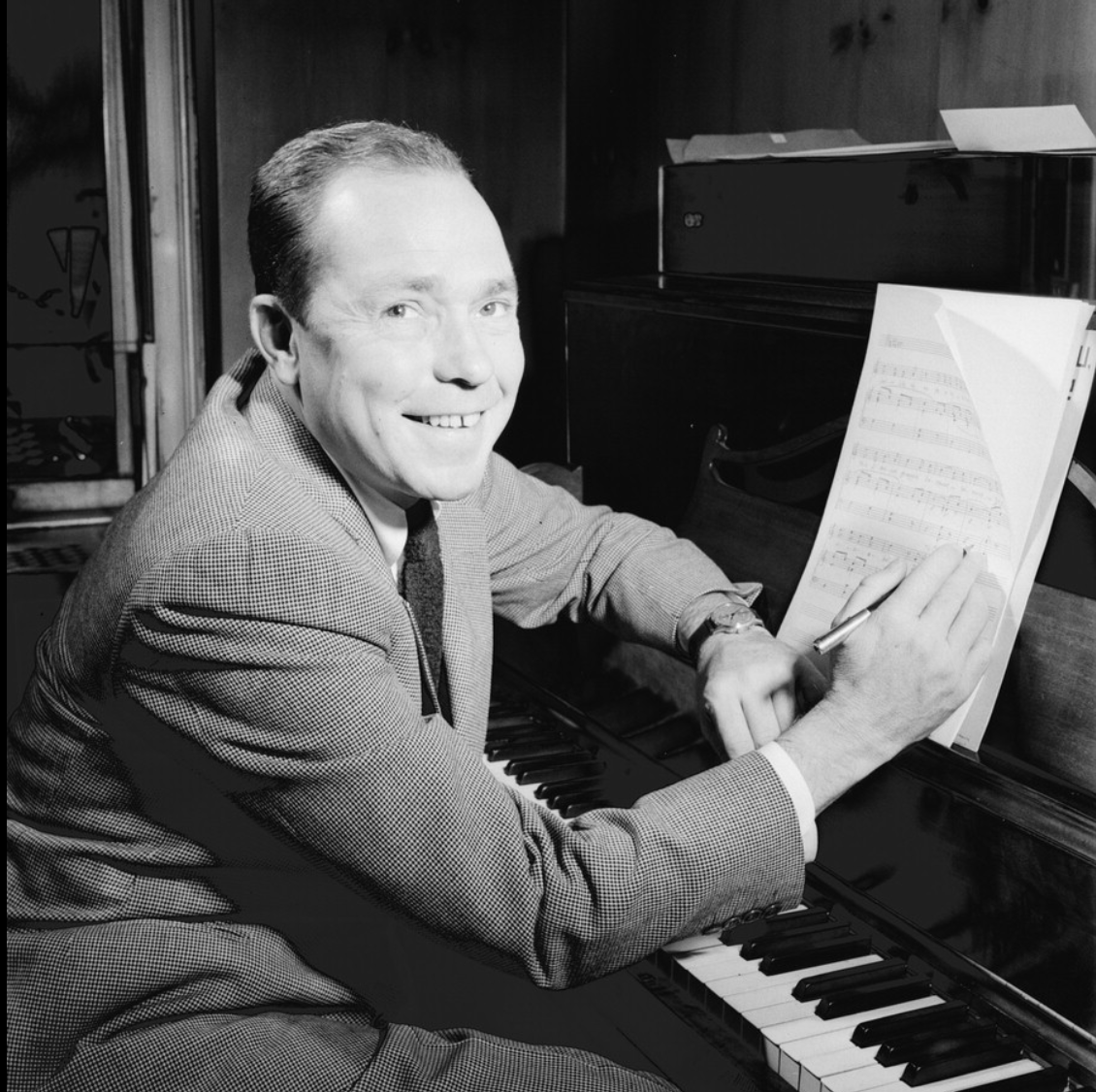
Composer Harry Warren and lyricist Johnny Mercer, for example, co-wrote “Jeepers, Creepers,” “On The Atchison, Topeka and the Santa Fe,” and “You Must Have Been A Beautiful Baby.”
Johnny Mercer in the 1940s
And at some point Warren gave Mercer the nickname ‘Cloud Boy’.
As Warren explained, “A lot of times when I would play a melody for John… particularly if it was after a good lunch… he’d stretch out on a couch and just lie there with his eyes closed and his hands folded across his stomach. He was way up there some place in the clouds. Of course, what came out later was just great.”
When asked by his father about his creative process, Mercer once said, “I simply get to thinking over the song — pondering over it in my mind — and all of a sudden I get in tune with the Infinite.”
Many songwriters have expressed a similar sentiment — that they feel as though they are acting as a conduit or channel for something greater than themselves.
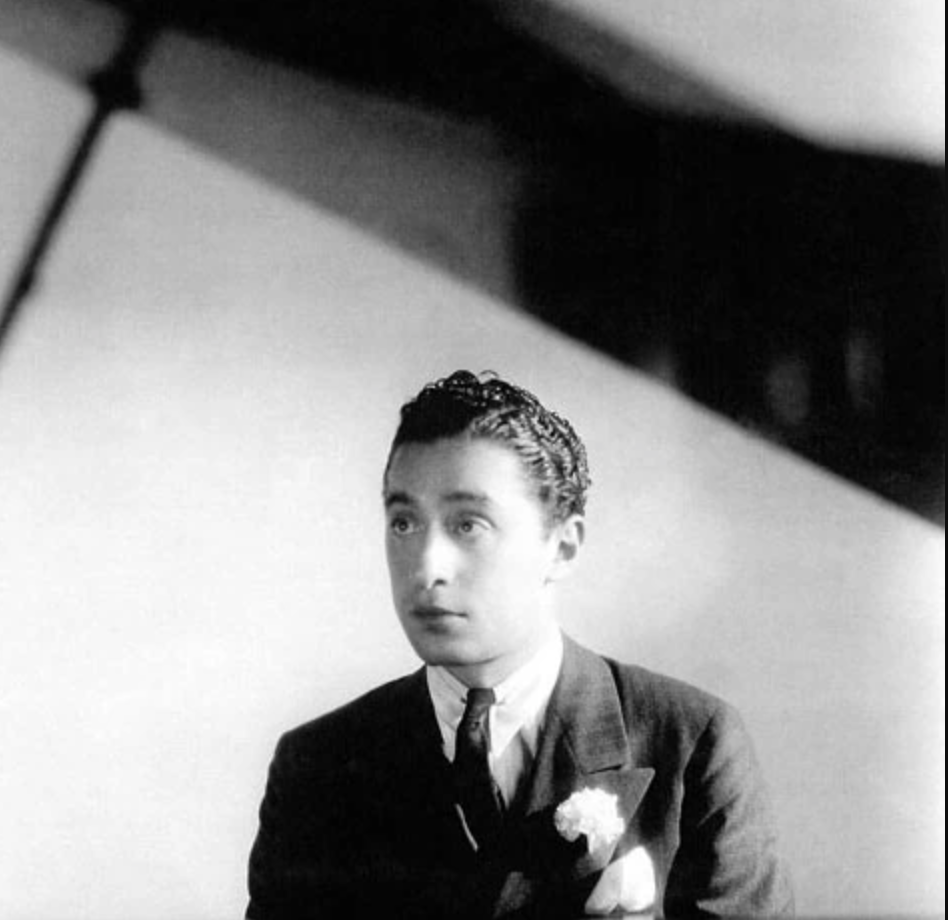
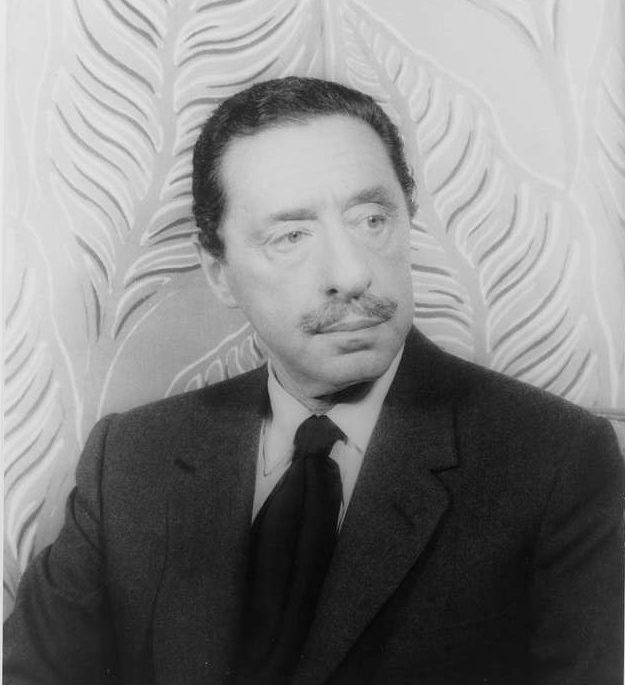
Harold Arlen
The lyricist Ira Gershwin said that the composer Harold Arlen would never “approach the simplest musical requirement or idea without first calling upon ‘the fellow up there’ — jabbing his finger at the ceiling.”
I cannot say that I have experienced this phenomenon yet.
I have, however, noticed that lyrical themes sometimes emerge which surprise me and lead a song in a different direction than I had originally intended.
And I have had the inspiring experience of writing a song which gradually became true.
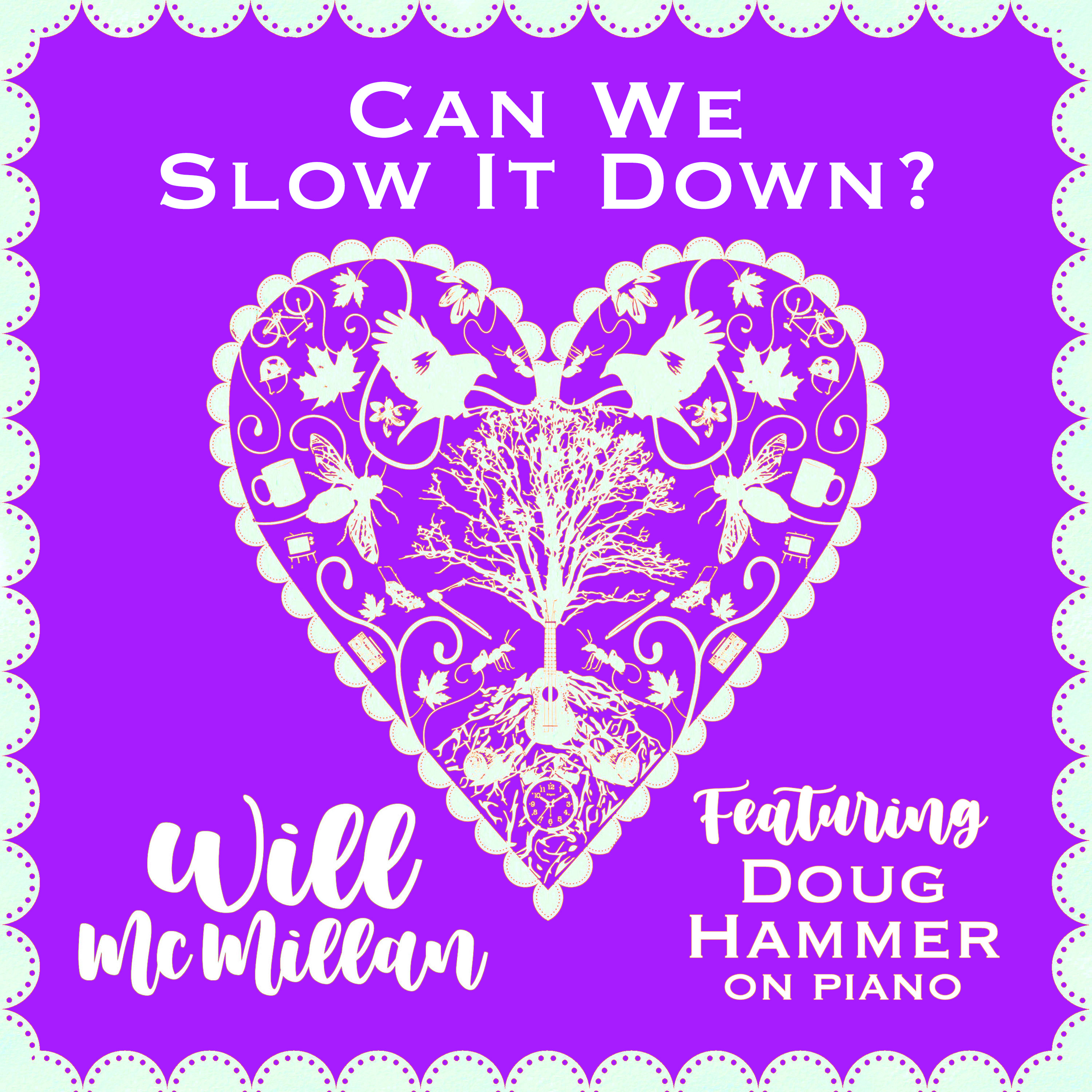
It is called “Can We Slow It Down?” — and I wrote it a couple of years ago when I was working full time at my day job in Harvard Square.
I realized recently when I was practicing it at home that my life has in fact slowed down since I began singing this song.
If you are curious, you can listen to two different versions of “Can We Slow It Down?” — the ukulele + GarageBand version at the top of this page and the piano/vocal version I released with pianist Doug Hammer by clicking here.
I will be singing it plus two other originals as part of a mini-set at a lovely open mic in Lexington — hosted by Nourish Restaurant on Massachusetts Avenue — on Tuesday, November 5, 2013, starting around 7:30 pm.
Steve Heck — a wonderful local pro — is playing the grand piano, and I am singing “Over The Rainbow.”
Harold Arlen
It is one of the songs in a new show about Harold Arlen which I have recently begun performing with pianist Joe Reid.
After Steve takes a piano solo, I re-enter at the bridge of the song (“Some day I’ll wish upon a star…”) and then I hear elevator doors opening behind me.
Three women — friends of Steve Heck, I later learn — appear on stage with me.
They did not realize that the elevator would deposit them there.
I turn and — still singing — welcome them so that I can escort them across the stage and down into the audience.
But as I do this, I realize that they probably love music and very likely know the words to “Over The Rainbow;” so I encourage them to stay with me onstage and sing — which they happily do.
One woman in particular catches my attention because she is adding a beautiful harmony in a great big, belting voice.
We make eye contact as the song builds to a dramatic climax of “Why oh why can’t I?” — each of us singing at the top of our lungs, my microphone completely unnecessary.
The entire series of events lasts less than a minute, and the entire room is happily caught up in the moment.
Afterwards, during a break period, I am asked how I managed to time their arrival so perfectly.
I explain that I had never met them before and that the entire experience was utterly spontaneous — unfolding moment by moment with no guidance other than the lyrics of the song, Steve Heck’s solid accompaniment, and our shared love of music.
Ahh, music!
Ahh, spontaneity!
Joe Reid
I have been experiencing a lot of spontaneous musical moments in the past few months.
Joe Reid and I put together our hour-long Harold Arlen program in one rehearsal that lasted about two hours.
He is a jazz pianist who is very comfortable making music in the here and now.
I brought a bunch of Arlen sheet music to his house plus a rough idea of a song run order.
We double-checked the keys for all the songs, played each one through once or twice, and Joe was ready to take it public.
So far we have performed at two retirement communities with very enthusiastic audiences (and we did get together for another hour-long rehearsal between our first and second performances…)
I also spent many additional hours making sure I knew exactly how the song was originally written, reading several books about Arlen I ordered from my local library, recording practice piano tracks with Doug Hammer, memorizing lyrics, and writing the “patter” to lead from one song to the next.
All of this preparation helps me to surrender to the moment when we are performing these wonderful songs.
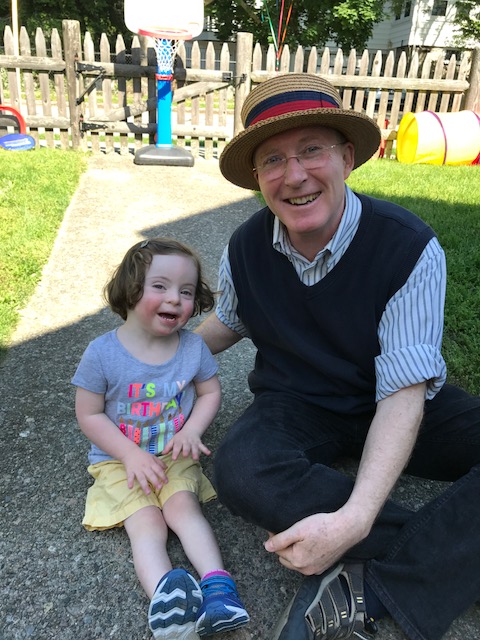
Me and one of my favorite MT participants of all time!
I have also begun leadingMusic Together (MT) classes in Arlington and Belmont (a neighboring town where Mitt and Ann Romney used to live).
MT is a very-well-researched and very-well-planned program to introduce small children — along with their caregivers — to the joy and fun of active music-making.
Although participants are encouraged to learn 30 new songs accurately — each one carefully selected to include a wide variety of keys and rhythms — per semester, we teachers are given free rein to be spontaneous and improvisatory during class.
I am sure my training during the past six months to become a MT teacher helped me to go with the flow at the BACA open mic when those three women appeared onstage.
And I have experienced many moments of musical connection with children and caregivers during my first two weeks of MT classes which have given me a similar jolt of delight.
I think this might be what I am supposed to be doing here on planet earth…
The song in the player at the beginning of this blog post is a Harold Arlen/Johnny Mercer classic called “Accentuate the Positive” which I recorded with pianist Doug Hammer during a rehearsal for the “Mostly Mercer” show that singer Bobbi Carrey and I created last year.
As some of you may know, I recently returned from a sweet trip to visit friends in Shanghai.
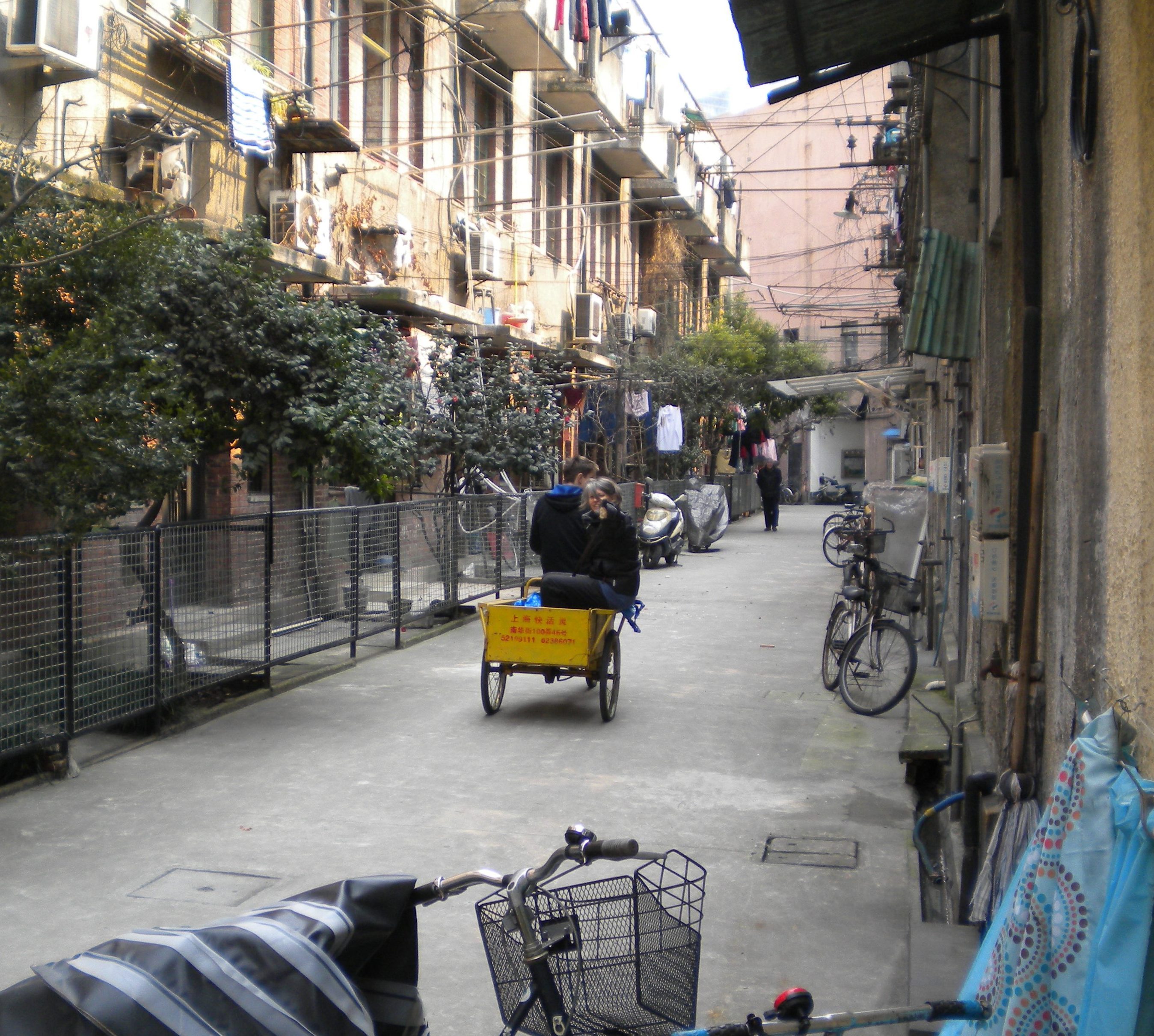
Heading out on the tricycle…
They live in a row house on an alley — many of which are being torn down in order to build apartment/condo skyscrapers.
There was lots of eating, biking, exploring the city and making music.
Although there are MANY motorbikes, cars and trucks in Shanghai — as well as a beautiful and enormous new subway system — lots of people still ride bikes.
My friends had several black single-speed bikes and also built a big trike with a yellow rear bed for transporting things and people around town.
There were items for sale everywhere — including fresh fruits and vegetables; live turtles, frogs and fish; and much, much, much, much more.
One of my friends is a wonderful composer, jazz pianist, and teacher.
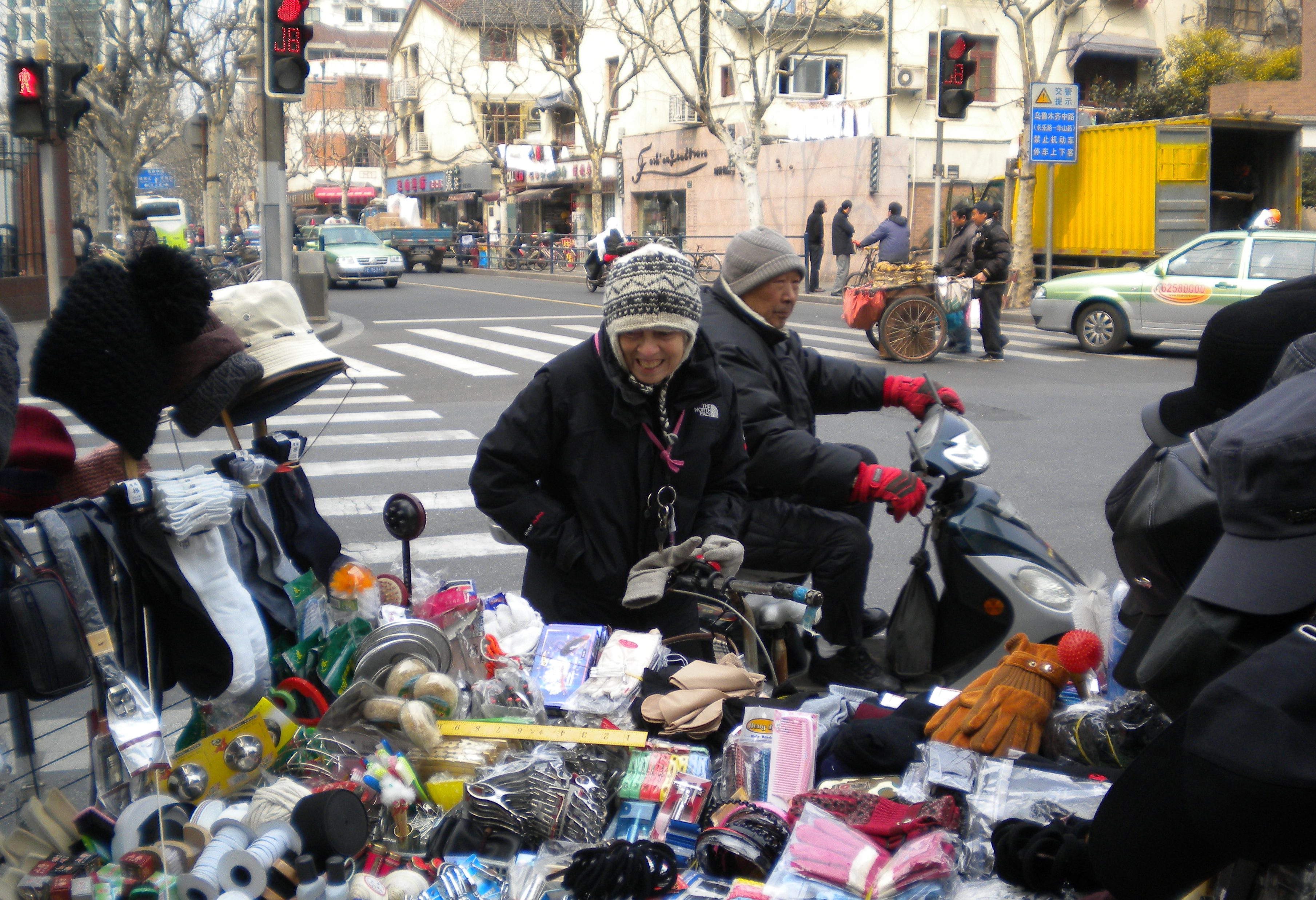
My friend’s mother checks out a street vendor’s wares…
He and his family have been living in Shanghai for seven years, and a couple of years ago he started teaching music in the school his younger child attends.
I was able to visit some of his classes and was happy to see — and hear — how much his students love to sing.
We even taught them a song that my friend and I had written together — back when he lived with his Yamaha grand piano in a studio apartment above an ice cream store in Allston, MA — called “Let’s Go To The River.”
They learned it quickly and sang it with great gusto.
I was delighted.
A few days after I returned home to Boston, when it looked like my friend’s primary vocal ensemble might be participating in a VIP concert for the mayor of Shanghai, two of China’s top conductors came to hear my friend’s choir sing.
Me walking near the Bund, I think…
They listened to three pop/rock/show tunes, responded warmly, and asked, “What else do you have?”
My friend projected the lyrics for “Let’s Go to The River” up on a screen at the front of his classroom, and his choir performed a rousing version for them.
After class, the conductors stayed to talk about his choir participating in the concert. One of the maestros tactfully mentioned the importance of choosing songs with lyrics that would be apolitical. He suggested “What a Wonderful World,” my friend suggested “Singing in the Rain,” and they decided that a song in Chinese would be great, too.
The maestro again reinforced the necessity of choosing lyrics with an eye to political sensitivity.
My friend didn’t think too much about the maestro’s remarks until after they had left — and he went back into his classroom and saw my lyrics still up on the screen.
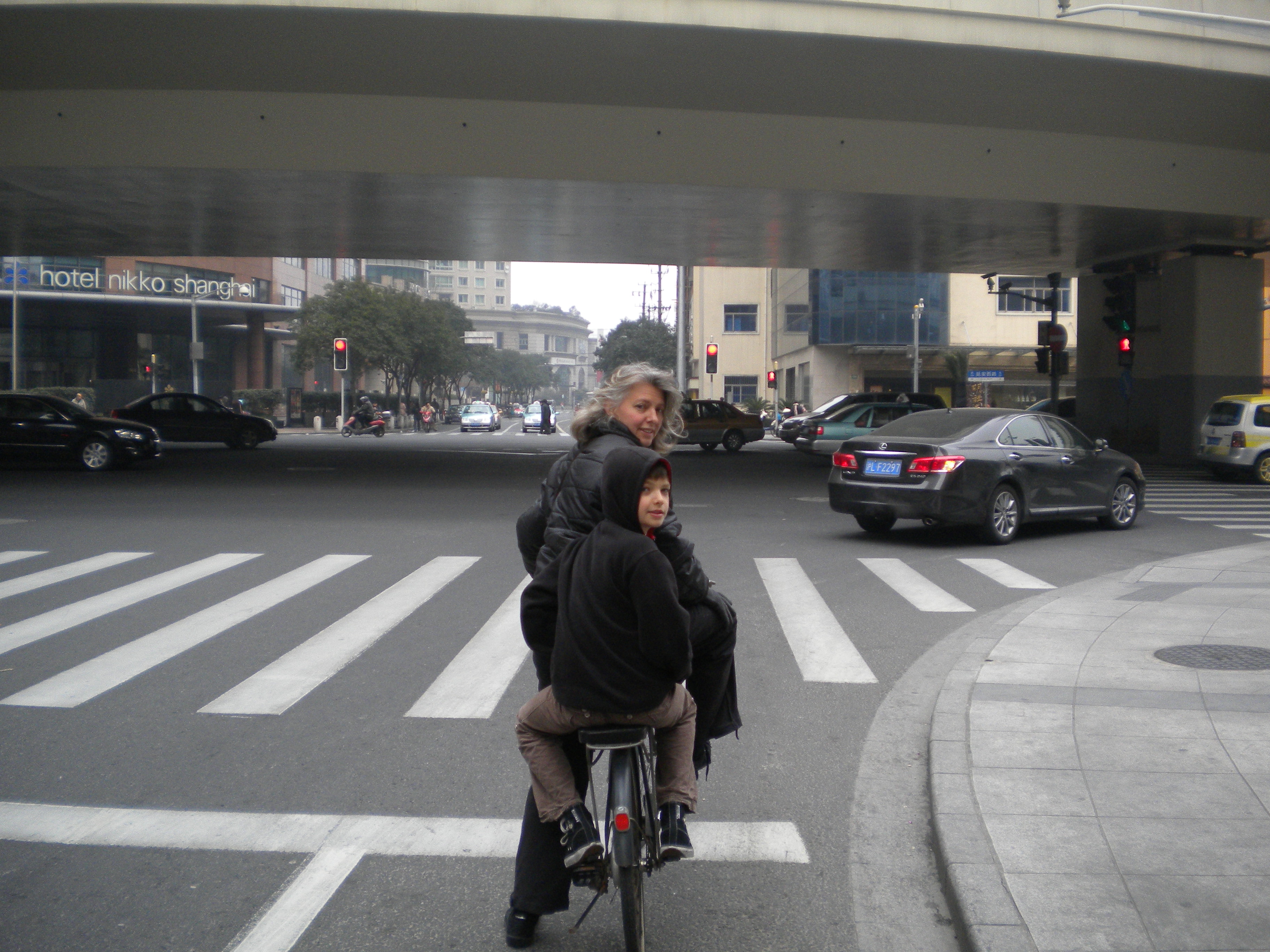
Lots of people ride double like this on their bike…
The two conductors had had time to study the message of “Let’s Go to the River,” and my friend realized that it may have made them nervous that he was teaching such ‘subversive’ messages to primary school students — and might even want to perform such a message at a public event.
I have typed the lyrics at the end of this blog post.
Perhaps they are a bit subversive for our ever-more-wired-and-plugged-in-and-distracted culture in the United Stated of America, too!
What do YOU think?
Thank you to my friends for flying me to Shanghai not once but twice during their years there.
Thank you to Steve for giving me a melody many years ago to which I set these lyrics.
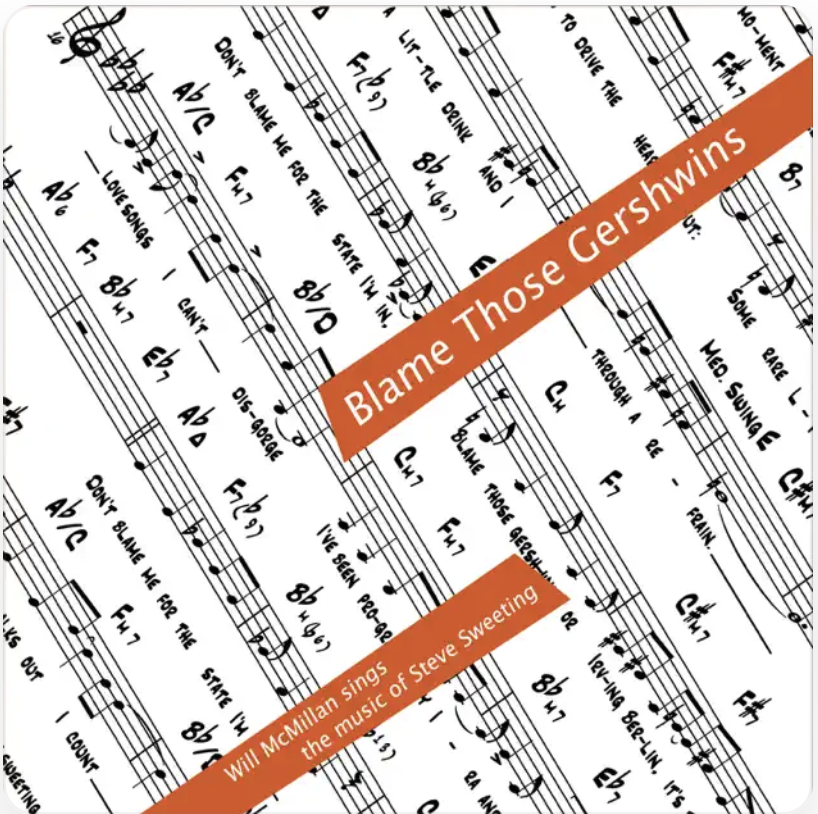
Thank you to Kate for her lovely graphic design for the CD — BLAME THOS GERSHWINS — of Steve’s songs which we recorded a few years ago.
And thank YOU for reading (or re-reading) this blog post!
I started playing the ukulele three years ago after attending a class in Harvard Square led by the marvelous Danno Sullivan.
Danno Sullivan
Not only is Danno an inspiring teacher, he also has a terrific sense of humor — sprinkling his classes with droll asides and insights.
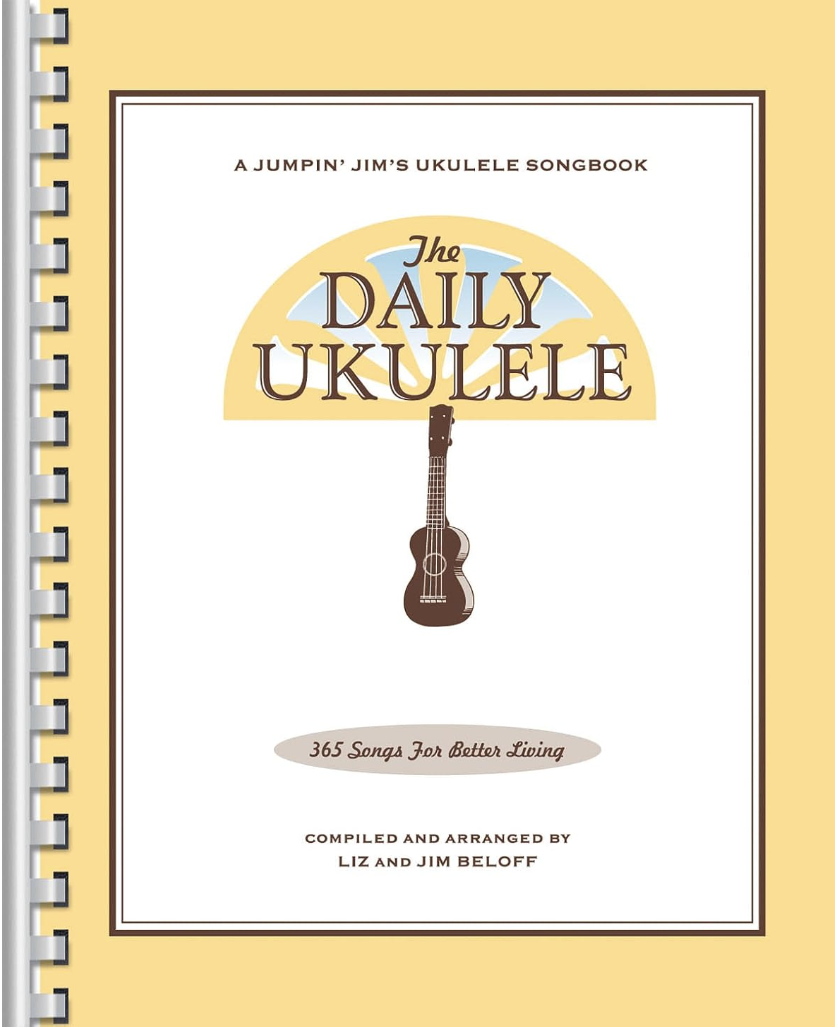
Since then I have been strumming on a regular basis — thanks to Danno’s handouts, the wonderful Daily Ukulele songbook, and the amazing group mind of the internet (where one can find chords and lyrics for almost every song under the sun).
Soon after discovering the chords for Coldplay’s song “Viva La Vida” on line, I realized that many of my favorite pop songs have a surprisingly simple structure — four chords.
And some do fine with just three chords — as in the case of Bobby McFerrin’s “Don’t Worry, Be Happy.”
And thus my life as a budding songwriter took root…
Deep breath in.
Deep breath out.
I had written lyrics in the past with a friend, pianist/composer Steve Sweeting (and you can listen to one of the songs we created together called “Stuff” by clicking here if you are curious).
I had also collaborated on a couple of songs with a guitarist friend (again as a lyricist).
And I had co-written a couple of songs with bandmates in a pop/rock band.
But until I picked up a ukulele, my songwriting efforts had been restricted to what I could cobble together using Apple’s blessed GarageBand program — songs consisting of my vocals plus various loops and samples from the GarageBand library.
Now, in the past three years, I have written a bunch of ukulele-based songs.
And in the past month I have attended three singer-songwriter open mics — accompanying myself (solidly but not very gracefully) on the ‘uke.
In addition to helping me write songs, the ukulele has also given me a new way to hang out with my mom, with my dad, and with other friends and family members.
All I have to do is pick up a ‘uke, open up a songbook, and start strumming.
Almost invariably the mood in the room shifts to something lighter and (literally) more harmonious as everyone starts to hum and sing along.
I find this to be somewhat magical and amazing.
And it inspired me to write the song featured at the beginning of this blog post — a version which I recorded with Doug Hammer playing a shaker egg and his Schimmel grand piano — as well as a GarageBand version I recorded by myself using my Apple laptop (which I have included below.
I highly recommend that anyone reading this blog post consider buying a decent (but inexpensive) ukulele.
Then you can check out all sorts of fun, free, instructional videos on YouTube AND start attending a wonderful, welcoming ukulele Meetup gathering near you.
They happen all across the USA — and in many other countries around the world.
And the sound of many ukuleles being strummed together is quite heavenly.
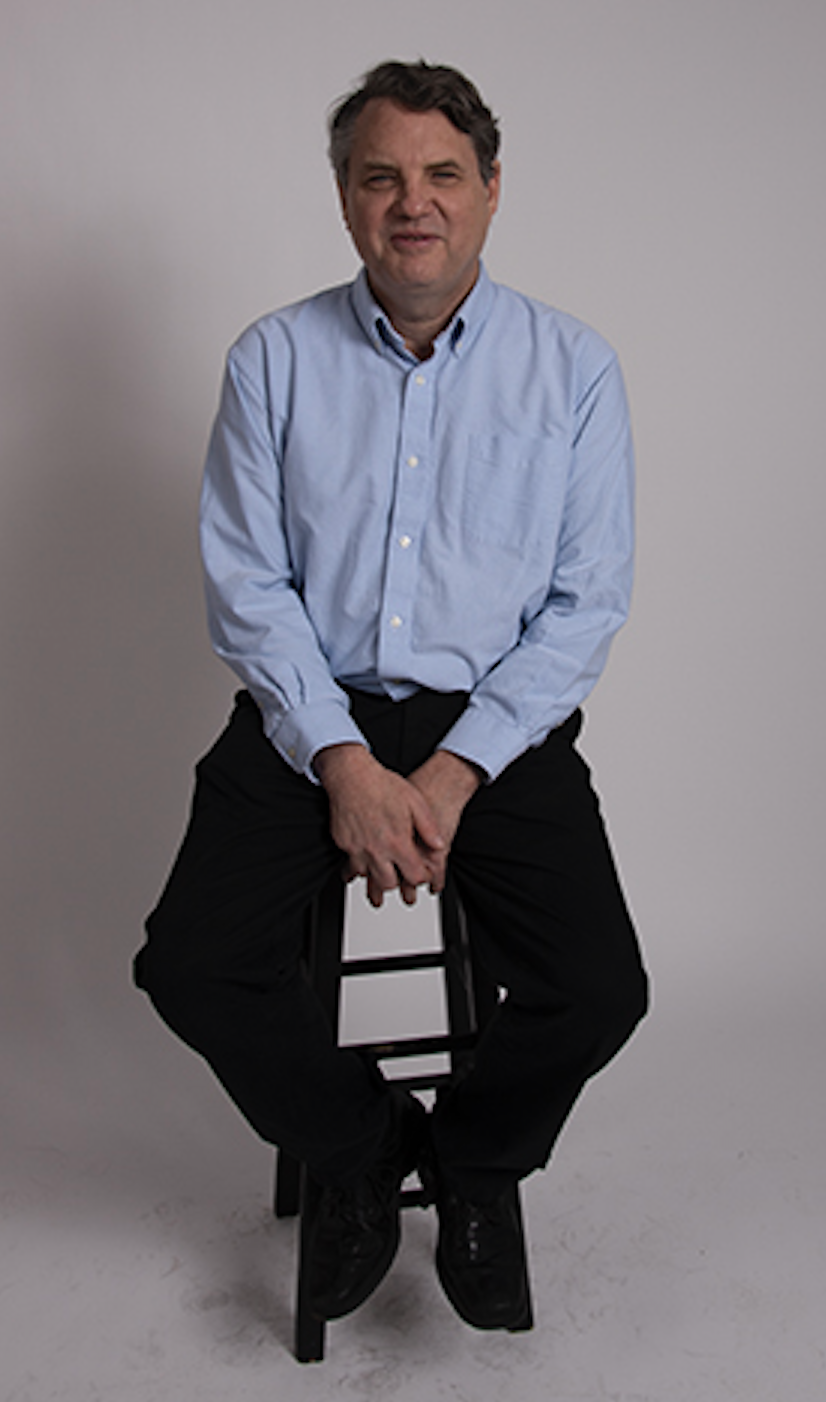
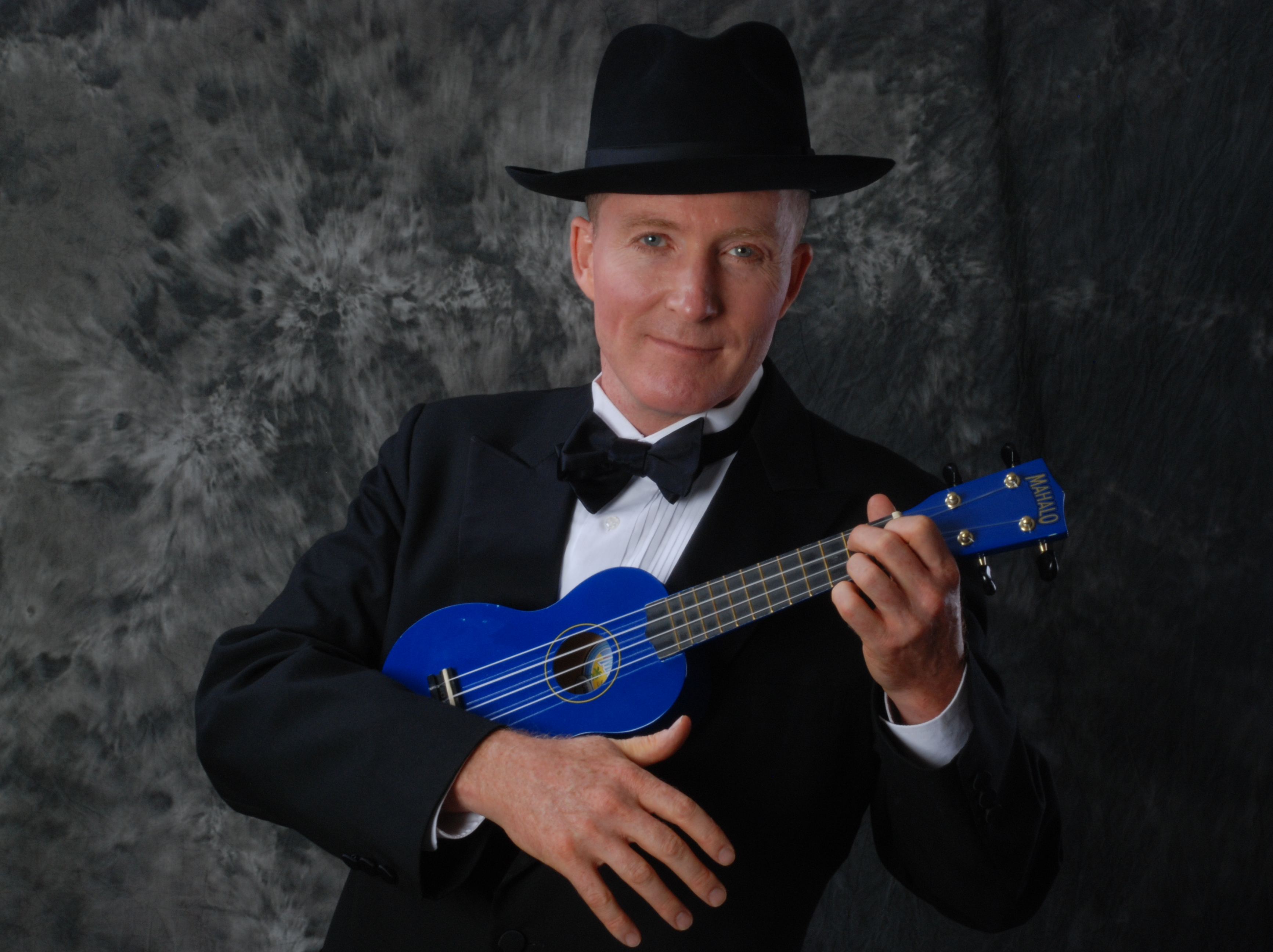
Me and my first ukulele (Photo by Stephen C. Fischer)
Thank you, too, to Danno Sullivan for his excellent instruction and ongoing inspiration.
Thank you as well to the Cambridge Center for Adult Education for offering ukulele classes with Danno (and to Michael Cicone — then head of educational programming at CCAE — for hiring Danno in the first place).
Thank you to Stephen C. Fischer for his fun — and very patient — photography sessions.